What the MRI Really Took


I thought I understood Uhthoff’s phenomenon.
Heat flares symptoms.
Cool down.
Reset.
Move on.
That’s been my pattern.
Last week I wrote about seventy-five minutes in an MRI tube.
No need to replay it.
You were there.
What I didn’t understand until afterward was this:
It wasn’t the confinement that unsettled me.
It was the loss of agency.
There’s a specific kind of distress that doesn’t come from pain. It comes from realizing you cannot intervene.
You can’t cool yourself down.
You can’t move.
You can’t recalibrate and reset your internal compass.
You just lie there while your body becomes less cooperative.
Lying in the MRI decades later, warming slowly, I wasn’t just feeling my legs drift.
My spine lit up.
It started as heat and turned electric — a bright internal surge running upward. Then my neck felt like it gave, as if the structure holding my head steady had quietly stepped away.
I couldn’t adjust.
I couldn’t shift.
I couldn’t brace.
I wasn’t just reacting to heat sensitivity.
I was experiencing my body lose its structural reliability while I was required to remain perfectly still.
And in that stillness, something older surfaced.
Because I’ve seen this before.
When I was five or six, my older brother and I watched our mother trip and fall. Not once. Often.
There’s a particular sound a body makes when it meets the floor unexpectedly. It’s not dramatic like in the movies. It’s quick. Awkward. Final.
As kids, we didn’t understand demyelination or lesion burden or conduction velocity.
We understood gravity.
We understood the split second where balance disappears.
We understood the look that follows — not pain, exactly — but the frustration of a body that didn’t do what it was told.
It’s hard to see that happen to anyone you care about.
Harder when you’re small and can’t fix it.
For a brief moment, the old template flickered:
“This is how it starts.”
But here’s what’s different.
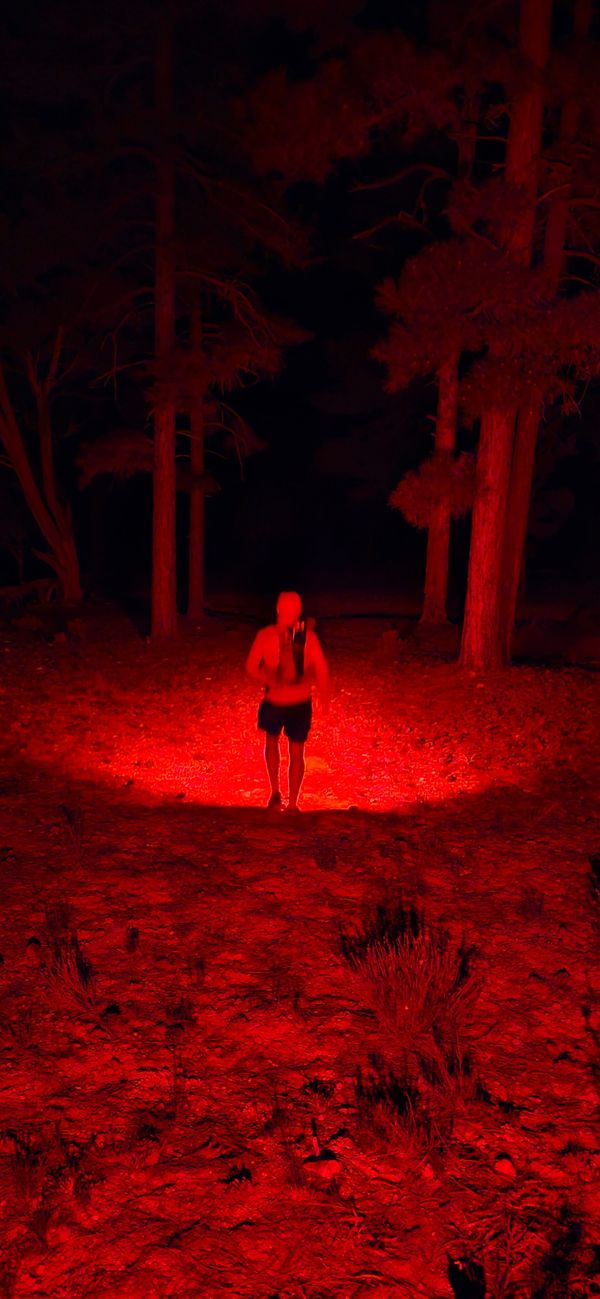
In a few months, I plan to run Rim-to-Rim-to-Rim across the Grand Canyon. In May. In heat. Fully aware of what temperature can do to my nervous system.
Anyone who knows that route knows about The Box — that narrow corridor between Phantom Ranch and Manzanita where the canyon walls trap heat and radiate it back at you. It’s an oven. Air temperature climbs. The rock radiates. Exposure compounds.
For most runners, The Box is uncomfortable.
For someone with MS, it’s negotiation.
Heat doesn’t damage me in that moment. It interferes with conduction. It slows signal along already vulnerable wiring. Symptoms can whisper louder. Legs can feel unreliable. Vision can blur. The body drifts.
The difference is this:
Inside the MRI, I had no levers.
Inside The Box, I will.
Pace.
Hydration.
Cooling strategy.
Shade.
The option to turn around.
The MRI simulated heat without agency.
The canyon will offer heat with choice.
That distinction matters.
I am not a child watching from the hallway anymore.
I am not living in an era without options.
And MS is not a single, predetermined script.
The MRI didn’t take my future.
It took my agency for a few minutes.
That’s not the same thing.
Nine days later I’ve run. I’ve trained. I’ve pulled back volume intentionally because recovery is strategy, not surrender.
My mother navigated MS in a different time — fewer tools, fewer options, less transparency about what was happening inside the brain.
I get monitoring.
I get data.
I get choices.
I get to navigate it with information, strategy, and perspective.
The tube reminded me how vulnerable agency can feel.
The canyon will test whether I can manage it.
Gravity may win a moment.
Heat may demand humility.
But neither gets to write the whole story.