Normal, Under Controlled Conditions

I didn’t go to the neuro-ophthalmologist looking for reassurance. I went because something about how I was seeing the world no longer felt negotiable.
By the time I sat in that chair, I wasn’t untreated or untouched by the system. I’d already begun therapy months earlier. Whatever this was, it had survived first contact.
Vision problems are strange that way. You can compensate for a lot — fatigue, pain, even weakness — but when perception itself feels unreliable, there’s nowhere to stand. You can’t tell whether the problem is out there or inside you. You just know something is off.
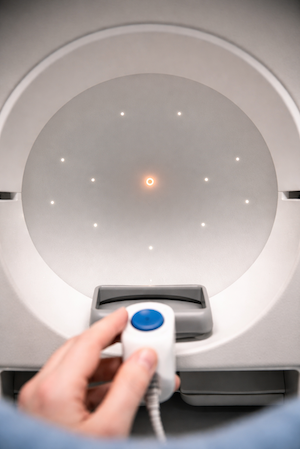
The office was calm in the way medical spaces often are: controlled lighting, neutral colors, an efficiency that suggests competence without promising answers. Tests followed tests. I stared into a dome for the visual field exam, clicking a button in the dark whenever a pinprick of light appeared — or when I thought it did. Later, my chin rested on a plastic support while an OCT machine scanned my optic nerve, quietly mapping structures I couldn’t feel but had learned to worry about.
Measurements piled up. Charts. Numbers. Cross-sections of tissue rendered into grayscale precision. Everything precise enough to inspire confidence, but not clarity.
Structurally, nothing was wrong. Functionally, I passed every test well within normal limits. The neuro-ophthalmologist found nothing of concern.
I could have taken that as deflating. Instead, I recognized that I still had a choice in how to process it.
On the drive home — from the opposite side of town, straight into bright afternoon sun — I felt my eyes begin to wear down. Not all at once. Subtly. First, a dull ache at the back of my head. Then pressure around my right eye. Then the familiar realization that the double vision was quietly returning.
The tests hadn’t missed anything. They just weren’t built to capture this part.
I picked up my son from daycare and drove home carefully. By the time we arrived, the fatigue had settled in fully. I lay reclined with Benito asleep on my chest, still strapped into the tactical baby carrier. His weight, his breathing, the warmth pressed against my ribs — it was the most soothing moment of the day.
That contrast stayed with me. On paper, everything was normal. In practice, my body had reached a threshold the instruments couldn’t see.
What I noticed most wasn’t fear. It was calibration. The machinery could quantify blind spots and nerve thickness, but it couldn’t account for cumulative strain, light sensitivity, or what happens after the exam is over — when life resumes and the nervous system has to keep going.
There’s a peculiar humility in that realization. You want the test to catch up to your intuition. You want a clean answer. You also don’t, because clean answers change things.
I left without a diagnosis and without relief, but with something else instead: a clearer sense of signal. This wasn’t imagination. It wasn’t panic. It was information — just not the kind that fits neatly into a chart.
I’m learning that this is what many medical encounters are really about — not answers, but calibration. Learning when to press, when to wait, and when “normal” is simply a snapshot taken under controlled conditions.
I don’t know yet what this signal will resolve into. I only know that staying curious — rather than deflated — has become its own kind of discipline.
For now, that’s enough.